10 Mysterious Places Where Water Vanishes Without a Trace
3. Greenland Ice Sheet: Disappearing Lakes on a Massive Scale
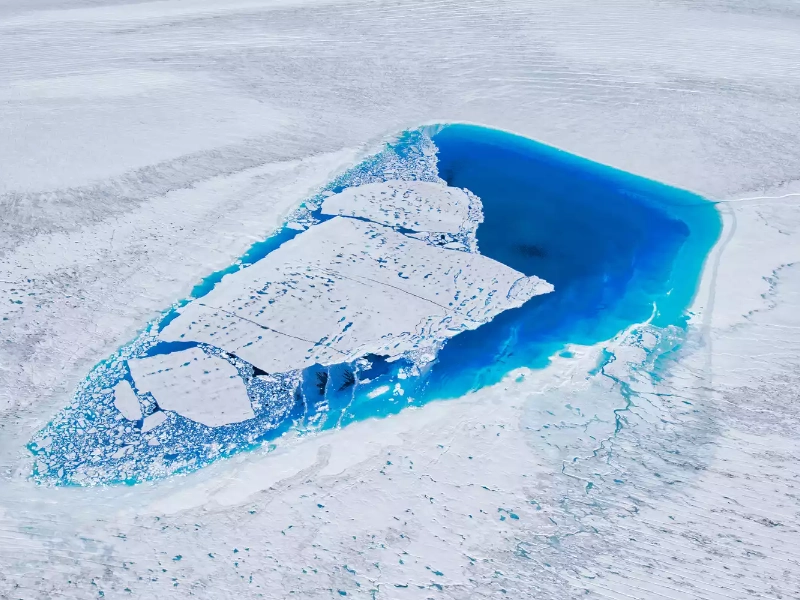
Subsequent studies revealed that these lakes had drained through moulins, vertical cracks in the ice. These fractures provide a direct pathway for surface water to reach the bedrock beneath, extending from the surface all the way to the bottom of the ice sheet. The process is often self-reinforcing; as water flows through these cracks, it can widen them through hydraulic fracturing and melting, potentially leading to even more rapid drainage in the future.
The formation and disappearance of supraglacial lakes on the Greenland Ice Sheet is closely linked to climate change. As global temperatures rise, the rate of surface melting on the ice sheet increases, leading to more frequent and larger supraglacial lakes. The rapid drainage of these lakes is not merely a curiosity; it has significant implications for the overall dynamics and stability of the ice sheet.
Large volumes of water draining to the base of the ice sheet can act as a lubricant, potentially accelerating the ice's movement toward the ocean. This mechanism, known as basal sliding, could contribute to faster glacier retreat and sea-level rise. The influx of surface meltwater to the base of the ice sheet can also trigger a complex cascade of hydrological and thermal changes that further influence ice sheet behavior.
The study of supraglacial lakes on the Greenland Ice Sheet has become a critical focus in glaciology and climate science. Scientists are employing various methods, including satellite imagery, ground-based observations, and computer modeling, to better understand the formation, evolution, and drainage of these lakes. This research is essential for predicting the future behavior of the Greenland Ice Sheet and assessing its potential contributions to global sea-level rise.
The phenomenon of disappearing supraglacial lakes represents a striking example of the complex and often unexpected ways climate change is transforming Earth's cryosphere. As the world continues to warm, the dynamics of ice sheets and glaciers are likely to become increasingly unpredictable, emphasizing the urgent need for continued research and monitoring in these critical regions.