10 Mysterious Places Where Water Vanishes Without a Trace
4. Lost Lake: Oregon's Annual Vanishing Act
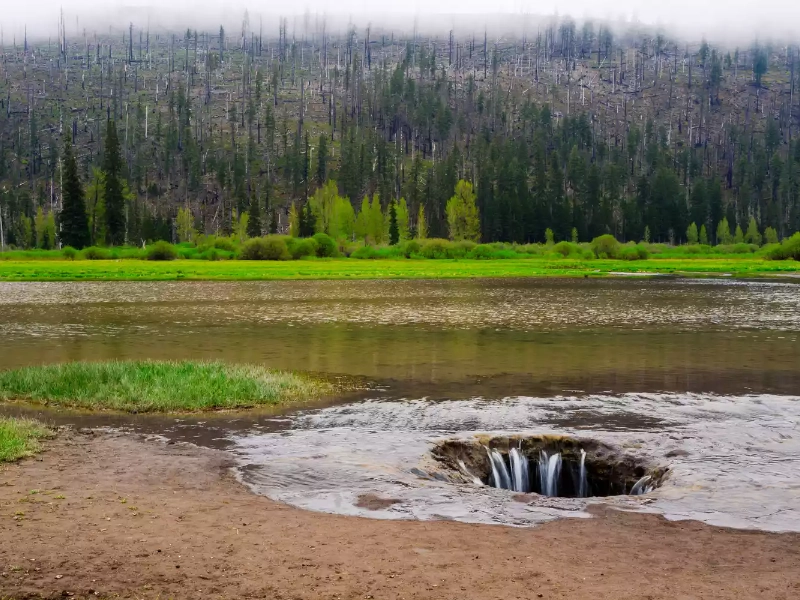
The secret to understanding Lost Lake's vanishing act lies beneath its surface. The lake sits atop a geological feature called a lava tube, a natural conduit formed by ancient lava flows. These lava tubes are common in volcanic regions, created when the outer layer of a lava flow cools and hardens while the still-molten interior continues flowing, eventually draining out and leaving a hollow tube.
In Lost Lake's case, this lava tube acts as a natural drain, continuously siphoning water from the lake bed. During the wet season, the influx of water from snowmelt and rain exceeds the rate at which the lava tube can drain the lake, causing the lake to fill. However, as precipitation decreases in late spring and summer, the drainage through the lava tube outpaces the water supply, and the lake eventually empties.
The drainage rates can be quite remarkable. At its peak, the lava tube can drain water faster than it can be poured in, creating a spectacle similar to a bathtub with an open drain. This process continues until the lake is completely empty, revealing the meadow floor beneath.
One of the most intriguing aspects of Lost Lake's drainage is that the ultimate destination of the water remains unknown. Forest Service scientists have speculated that most of the water likely percolates into the porous volcanic rock below. From there, it may contribute to the vast system of underground aquifers and springs that characterize the hydrology of the Cascade Range.
This annual cycle of filling and draining has important ecological implications. During the wet season, the lake provides water for wildlife and offers a temporary habitat for various aquatic species. As it drains, the nutrient-rich sediments left behind support the meadow ecosystem during dry months. This alternation between aquatic and terrestrial habitats creates a unique ecological niche that supports a diverse range of plant and animal species adapted to this cyclical change.
Lost Lake serves as a natural laboratory for studying the interactions between surface water and groundwater systems, providing valuable insights into the hydrology of volcanic landscapes. It also illustrates the dynamic nature of ecosystems and landscapes, reminding us that even seemingly permanent features like lakes can undergo dramatic seasonal changes.
As climate change continues to alter precipitation patterns and temperature regimes in the Pacific Northwest, the future behavior of Lost Lake and similar geological features remains a subject of active research and observation. Understanding these natural cycles and how they might be affected by changing climatic conditions is crucial for effective environmental management and conservation efforts in the region.
The story of Lost Lake serves as a powerful reminder of the intricate relationships between geology, hydrology, and ecology. It demonstrates how seemingly simple natural phenomena can reveal complex underlying processes that shape our landscapes and ecosystems. By studying and appreciating wonders like Lost Lake, we not only gain scientific knowledge but also develop a deeper appreciation for the dynamic and ever-changing nature of our planet.